
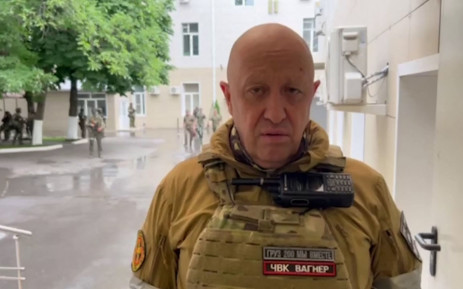

MOSCOW – In a surprising turn of events, the chief of the rebel Wagner mercenary force, Yevgeny Prigozhin, will travel to Belarus and avoid facing charges after calling off his troops’ advance on Moscow.
The Russian government’s decision has brought relief to the country, alleviating the most serious security crisis it has faced in decades.
The feud between Prigozhin and Russia’s military brass reached a violent climax when his forces captured a crucial army headquarters in southern Russia on Saturday and threatened to move towards the capital.
However, within hours of Prigozhin’s reversal, the Kremlin announced that he would leave for Belarus and neither he nor the members of Wagner would be prosecuted.
The day had been marked by tension, with President Vladimir Putin warning against the possibility of civil war, Moscow advising locals to stay off the streets, and Kyiv reveling in the chaos engulfing its enemy.
The situation took a sudden shift when Prigozhin made the stunning announcement that his troops were turning back to their field camps to avoid bloodshed in Moscow.
He expressed his understanding of the gravity of the moment and his desire to prevent the spilling of Russian blood.
Wagner troops were cheered as they pulled out of Rostov-on-Don, where they had seized the military headquarters.
Residents gathered outside the captured military facility, chanting “Wagner! Wagner!” with enthusiasm.
Authorities in the southern Lipetsk region lifted restrictions after earlier reports of Wagner fighters in the area, situated 420 kilometers (260 miles) south of Moscow.
Belarusian leader Alexandr Lukashenko announced that he had negotiated a truce with Prigozhin, receiving gratitude from Moscow.
Kremlin spokesperson Dmitry Peskov confirmed that the criminal case against Prigozhin would be dropped and that he would travel to Belarus.
Peskov also stated that Wagner members involved in the armed rebellion would not face prosecution, emphasizing the importance of avoiding bloodshed and internal confrontation.
The events have left Ukrainian government officials feeling that Putin has been humiliated.
Mykhailo Podolyak, a presidential aide, expressed on Twitter that Prigozhin had humiliated Putin and the state, demonstrating that violence is no longer a monopoly held by the Russian government.
While Russia claimed that the rebellion had no impact on its campaign in Ukraine, Kyiv viewed the unrest as a “window of opportunity” for its long-awaited counter-offensive.
Analysts predict consequences for Prigozhin and the Wagner group.
Samuel Bendett, a researcher at the Center for Naval Analyses, tweeted that there must be consequences; otherwise, the message would be that a military force can openly challenge the state, undermining the Russian government’s monopoly on violence within the country.
Rob Lee, a senior fellow at the US-based Foreign Policy Research Institute, suggested that cooperation between Wagner and the Russian military was likely to suffer.
He added that the repercussions of this event might be felt most significantly in the Middle East and North Africa (MENA) region, where Wagner has a significant presence.
While the Kremlin appeared taken aback, US intelligence agencies reportedly detected signs days ago that Prigozhin was planning to take action.
US media reported that they had been monitoring indications of Prigozhin’s intention to move against the military leadership since mid-June.
The Washington Post stated that US spy agencies believed Putin was informed about Prigozhin’s rebellion at least a day before it unfolded.

Amid concerns about Putin’s control over the nuclear-armed country potentially slipping, US President Joe Biden held conversations with the leaders of France, Germany, and Britain.
The United States and its allies initially remained on the sidelines, waiting to see how the revolt would unfold.
Moscow issued a stern warning to the United States and its allies, urging them to stay out of the rebellion, asserting that it played into the hands of Russia’s external enemies.
Before Prigozhin’s change of heart, Russian regular forces launched a counter-terrorist operation to halt the Wagner advance towards Moscow on a major highway.
Moscow Mayor announced “anti-terrorist” measures in the capital, and critical facilities were placed under reinforced protection.
The situation has left many Russians feeling saddened and uncertain about the events unfolding in their country.
Yelena, a 35-year-old resident of Moscow, expressed her sadness and uncertainty, stating, “I don’t know how to react. In any case, it’s very sad this is happening.”
As tensions ease and the crisis subsides, road traffic restrictions in various regions have been lifted, and security measures are gradually being scaled back.
President Putin addressed the challenge in a televised speech, accusing Prigozhin of stabbing Russia in the back and posing a threat to the nation’s survival.
He emphasized the deadly threat that internal turmoil poses to the state and called for national unity.
Putin condemned Prigozhin’s extravagant ambitions and personal interests, citing treason and alluding to his rise from a catering contractor to a powerful figure.
While Prigozhin’s group played a significant role in Russia’s offensive in Ukraine, he repeatedly blamed Defense Minister Sergei Shoigu and Valery Gerasimov, the chief of the general staff, for the deaths of his fighters.


