


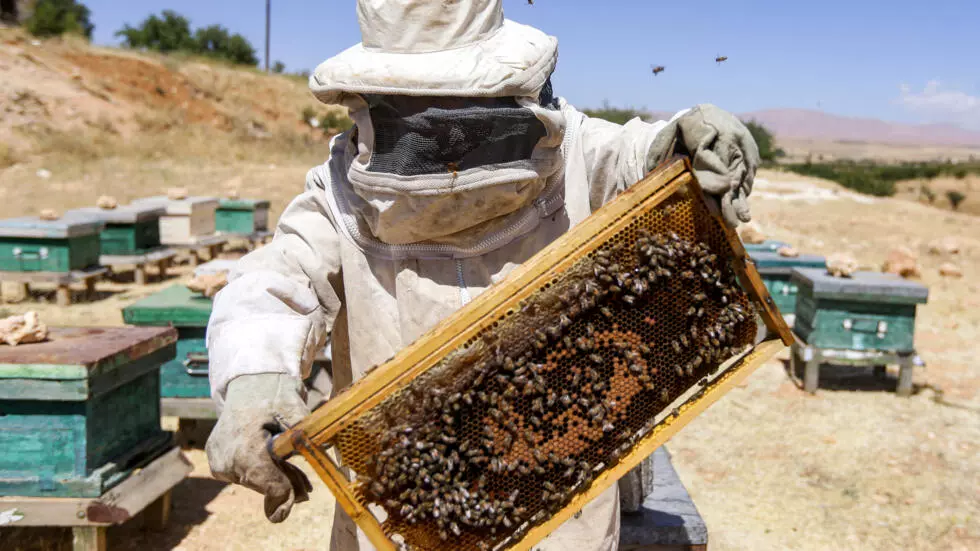
RANKUS (AFP)– Syrian beekeeper Ibrahim Damiriya faces enormous challenges as he strives to produce honey from his hives on arid land near Damascus, a result of years of war, economic collapse, and worsening climate change impacts.
Before the eruption of Syria’s conflict in 2011, Damiriya owned 110 hives in Rankus, a village near Damascus, known for its apple orchards and renowned honey production.
However, the combination of fighting, severe drought, and an economic crisis have dwindled his hives to a mere 40, severely impacting honey yields.
Rankus, once famous for its honey, suffered severe damage from clashes between government forces and rebels, leading to widespread destruction and the displacement of many residents.
Damiriya can hardly afford to maintain his hives, which were donated by the International Committee for the Red Cross (ICRC) to support Syrian beekeepers.
He voiced concerns about the future, saying, “If we continue to suffer from climate change and rising prices, I might have to abandon my profession.”
Since 2011, Syria’s war has caused over half a million casualties and triggered a dire economic crisis, exacerbated by harsh Western sanctions.
In recent years, the country has faced heatwaves, reduced rainfall, and increased forest fires.
A 2019 United Nations report revealed that the conflict had severely affected bee populations, with bombs contaminating the environment and pesticide misuse accelerating their decline.
Syria once boasted 635,000 hives before the war, but by 2016, only about 150,000 remained, according to Iyad Daaboul, president of the Arab Beekeepers Union in Damascus.
Today, that number has climbed back to 400,000 hives, but their yield is just 1,500 tonnes of honey per year, half of the pre-war production.
Unusually cold springs and droughts have adversely impacted the flowers that bees rely on for food.
Climate change, desertification, and deforestation have taken a toll on Syria’s vegetation, damaging the plants bees depend on for sustenance and hurting the agriculture sector.
Damascus ICRC spokesperson Suhair Zakkout revealed that Syria’s agricultural production had fallen by approximately 50 percent over the past decade due to war and climate change.
Despite being severely affected by global warming, Syria has been unable to secure the necessary funding to address environmental challenges.
Climate change has also devastated apple orchards, which have suffered from illegal logging driven by recurrent fuel shortages during winters.
Ziad Rankusi, a farmer who tends to his apple trees, lamented the impact of climate change on his land.
“For about five years, we have had unprecedented droughts and desertification, and this year the spring was unusually cold. The fruit perished,” he said, highlighting the critical link between climate change, agriculture, and beekeeping.


I think this is among the such a lot vital information for me. And i’m happy studying your article. However want to statement on few general issues, The website style is wonderful, the articles is actually excellent : D. Just right process, cheers
I visit daily a few sites and blogs to read articles or reviews, except this webpage offers feature based posts.
Hi there! Do you use Twitter? I’d like to follow you if that would be okay. I’m definitely enjoying your blog and look forward to new posts.
I’m not that much of a internet reader to be honest but your sites really nice, keep it up! I’ll go ahead and bookmark your website to come back in the future. Many thanks
Have you ever thought about writing an e-book or guest authoring on other sites? I have a blog based on the same ideas you discuss and would really like to have you share some stories/information. I know my readers would value your work. If you’re even remotely interested, feel free to shoot me an e mail.