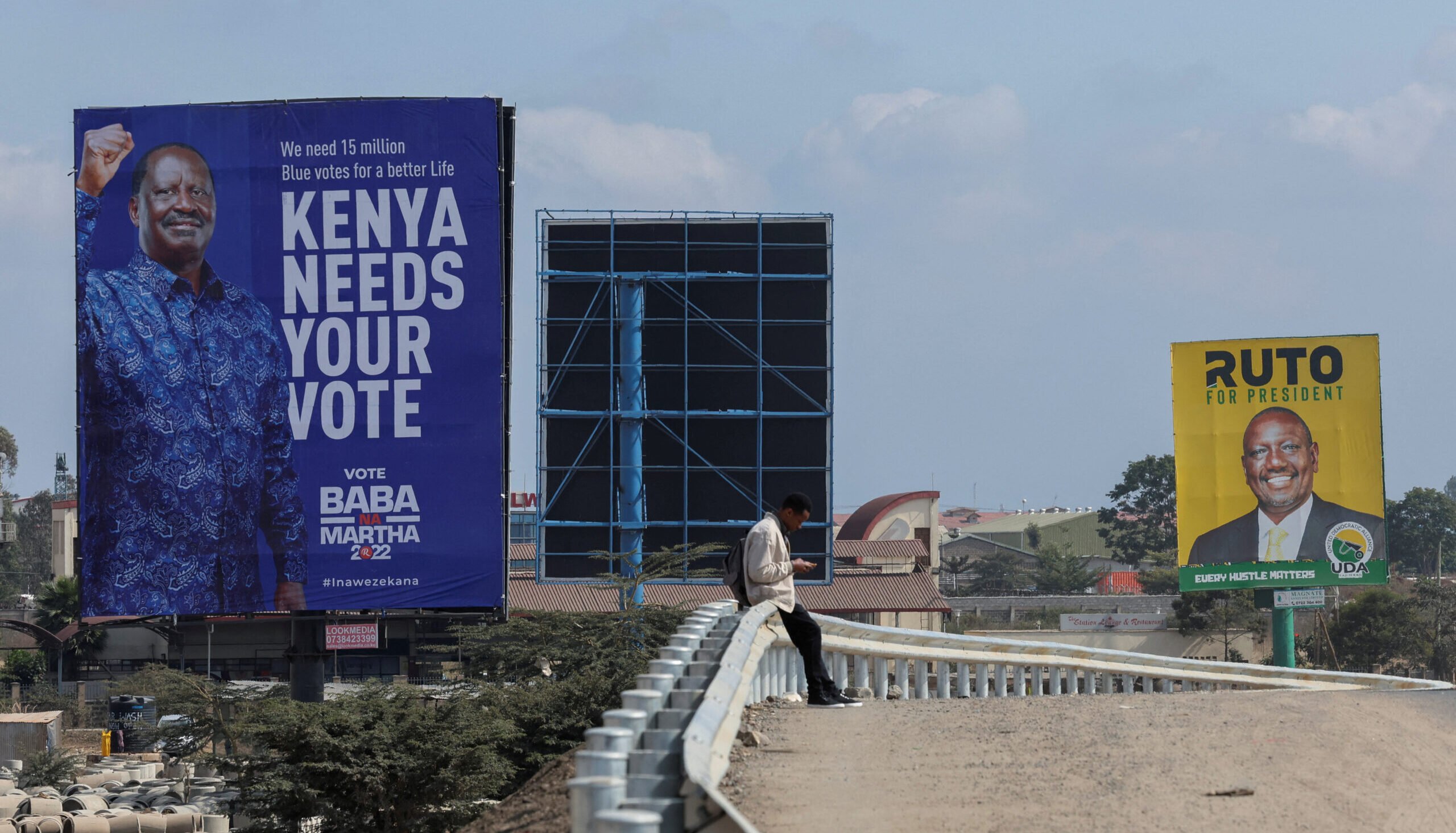

NAIROBI – Millions of Kenyans head to the polls next Tuesday as two political veterans William Ruto, and Raila Odinga are locked in a bitter battle for the presidency.
Memories of previous election violence linger and the country grapples with a cost of living crisis, growing inequality and crippling drought.
Four candidates are vying for the top spot, with a tight race between the frontrunner, Vice President William Ruto, and Raila Odinga, the opposition leader now backed by the ruling party.
The election campaign was dominated by slander, fake news and the practice of showering potential voters with gifts such as umbrellas, food and cash.
There is speculation that Kenya could have its first presidential run-off, and there are growing fears that discord could escalate into street violence if losing candidates challenge the results.
“It’s very difficult to say who’s going to win the election, because it’s all about who can be… the most emotionally attractive,” said Macharia Munene, professor of history at U.S. International University. in Nairobi.
The favorites are familiar faces: Odinga, 77, served as prime minister from 2008 to 2013 and Ruto, 55, became vice president in 2013.
But Ruto – long chosen as President Uhuru Kenyatta’s successor – saw his ambitions thwarted when his boss shook hands with longtime rival Odinga in 2018.
Kenyatta, who has served two terms and is no longer eligible, backed Odinga for August 9, giving him access to the powerful electoral machinery of the ruling Jubilee Party.
However, the handshake dealt a blow to Odinga’s anti-establishment credentials, leading to suggestions that he had effectively traded autonomy in return for Kenyatta’s support.
Lawyers David Mwaure and George Wajackoyah, the latter eccentric ex-spy who wants to legalize marijuana, are running for president.
Kenyans will also elect senators, governors, legislators, women’s representatives and some 1,500 county officials.
‘DRIVING THE KENYA APATHY’
The political shenanigans have fueled frustration, especially among young Kenyans.
About 22 million people have registered to vote, but the number of young voters has decreased compared to the 2017 poll.
“Politics doesn’t seem to solve problems, it just fuels apathy,” said Alex Awiti, an independent public policy researcher.
“So [voters] think it doesn’t really matter, the next president, the next senator, the next governor is just going to do what the other one did last time,” he said.
Odinga has pledged to crack down on rampant corruption and points out that Ruto’s running mate is fighting a corruption case.
Meanwhile, Ruto – with a ragpicking past and a dismal reputation – has targeted the “dynasties” that rule Kenya – a nod to the Kenyatta and Odinga families who gave the country its first president and vice president.
Ruto has described himself as a “cheater in chief” and a champion of the oppressed in a country where three in ten people live on less than $1.90 a day, according to the World Bank.
Kenyans, already affected by the Covid pandemic, are struggling to afford basic food items as war in Ukraine drives up prices.
“Customers who used to buy a lot of items… are now buying fewer,” said Peter Kibacia, a fruit and vegetable seller in Nairobi.
Any profit goes directly to household expenses, the 40-year-old father of three was quoted by AFP.
“At the moment, there is no economy.”
According to some observers, economic pressures may even rival tribal affiliation as a key determinant of voting behavior.
With neither Ruto nor Odinga belonging to the dominant Kikuyu tribe that has produced three of the country’s four presidents, the election will open a new chapter in Kenya’s history.
If Odinga wins, his vice president Martha Karua will become the first woman in office.
‘PRAY FOR PEACE’
Fears about the risk of violence persist – a reflection of the dark shadows cast by polls in 2007, which followed a horrific series of politically motivated ethnic clashes that left more than 1,100 people dead.
Odinga’s challenge to the 2017 election result was met with a brutal police response that left dozens dead.
Both polls were thought to be riddled with problems, with the Supreme Court ordering a rerun of the 2017 vote, citing widespread irregularities in the counting process and mismanagement by the Electoral Commission.
Concessions are rare in Kenya – no presidential election results have been contested since 2002.
The National Cohesion and Integration Commission, a peacebuilding body created after the 2007-2008 clashes, said there was a 53% chance of violence during the election period.
Schools have already closed, while some supermarkets have urged customers to stock up in advance.
Diplomatic sources sounded cautiously optimistic, but voters remain wary of intense pressure on the Electoral Commission to ensure free and fair elections.
“It’s fragile,” said Suzana Napwora, a 22-year-old student and first-time voter.
“But we will pray for a peaceful election.”
- Editor / additional report by AFP